West Somerset Railway Heritage Trust WSRHT

The Stationmaster’s Daughter

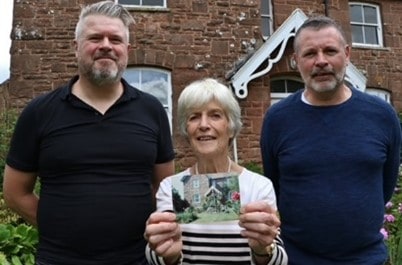
The West Somerset Railway (WSR) and the West Somerset Railway Heritage Trust (WSRHT) had the pleasure of welcoming back to her home of many years the Station Masters House, Bishops Lydeard, Mrs Marilyn Dickenson and her two sons, Frank and Jeff.

Jeff, Marilyn and Frank

The occasion was to mark a special birthday for Marilyn Dickenson, who is the daughter of the last station master, Frank Pardoe, at Bishops Lydeard station.

Frank Pardoe began his railway career in 1921 at Worcester, joining as a junior clerk on the GWR. In 1927 he was transferred to Birmingham. Then in 1945 still in Birmingham he was attached to the divisional superintendent’s office as a relief clerk and relief station master. In 1951 he was appointed station master at Bishops Lydeard taking over from retiring station master Mr Webber, known as Judge Webber, and moved to Somerset with his wife May (nee Parry) and two daughters, Marilyn Dickenson and her sister Janet.

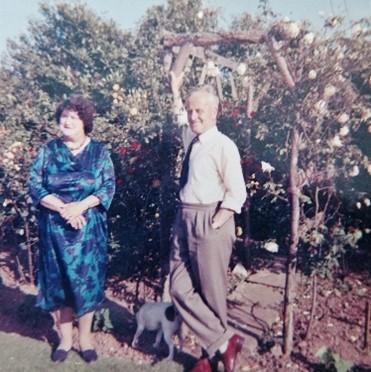
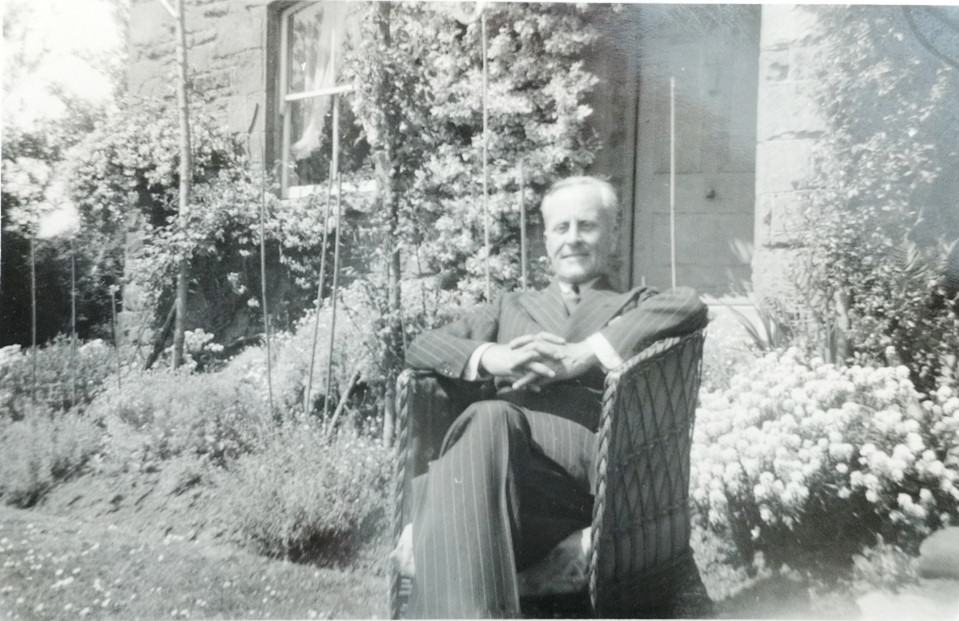
Frank & May Pardoe enjoying the rose arbor in the garden at Station House.
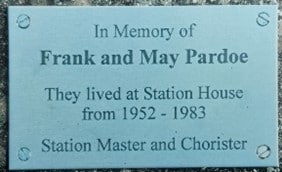
The plaque in Bishops Lydeard Parish church commemorating Frank & May.

Mrs Pardoe, (May) before she met and married Frank, was a well-known sprinter in Midland athletic circles and was a member of the famous Birchfield Harriers Women’s team which won the British championship at Stamford Bridge in the early 1920’s! After living as a full-time homemaker May worked for a period as a typist at Norton Military Camp.

Mr Pardoe was also able to indulge his passion for choral singing in Bishops Lydeard Parish church, where one can see a small plaque in memory of Frank & May.

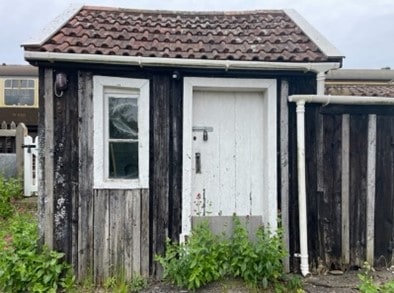
The former washhouse now potting shed with coal shed/Bess the pony’s stable.

Marilyn was able to relive her time living in the station master’s house showing us where they got their hot water from, the shed that Janet housed her pony, Bess, and that was later used as a coal shed.

When they moved into the house there was no electricity, even in the early 1950’s, and heating was via coal fires in every room, until gas was installed and then the lounge was fitted with the luxury of a gas fire.

The family generally ate in the kitchen, there was a coke stove in the recess in the kitchen for heat and hot water, with the pantry at the far end. Once gas was installed a gas cooker was an added luxury.

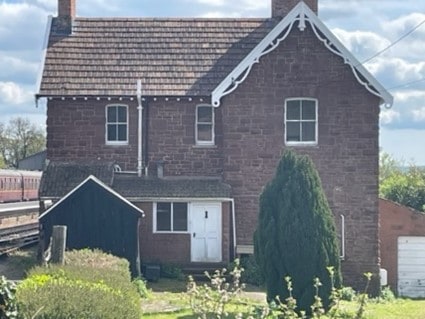
The back door to the house with garage to the right where the chicken house was.
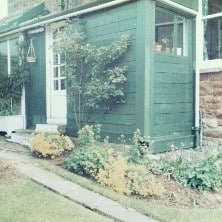
The wooden porch over the back door also enclosing the butlers sink.

As Marilyn walked around the gardens, she pointed out that where the garage is now, was where her father had his chicken house and run. The potting shed formerly the wash house. In this shed was a large round brick structure that held an open basin, heating the water for washing, by an open fire underneath. The mangle was also stored in the shed. The current butler sink to the right of the back door, was originally enclosed in a wooden porch.

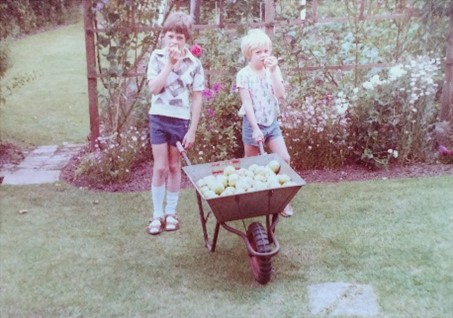
Frank and Jeff helping Grandad Frank pick the apples.
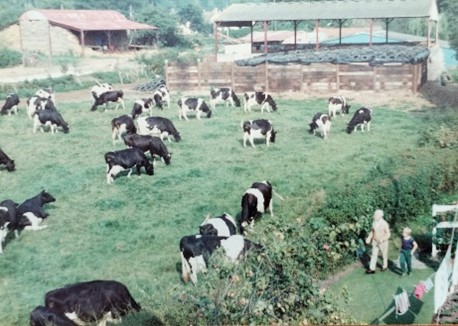
The view from the top bedroom overlooking Pattemores farm plus their cows with Mr Pardoe and grandson in the bottom RH corner.
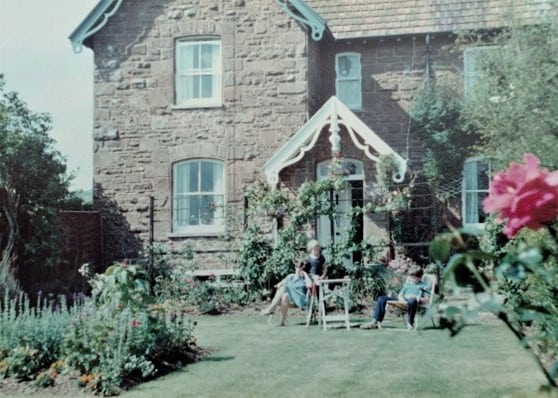
Marilyn, Frank and Jeff enjoying the sun and afternoon tea in the front garden of the house.

The back garden was an orchard garden with a small lawn area bordered by a narrow flower bed with a rose trellis screening a large vegetable garden. Frank Pardoe was a keen gardener and grew runner beans, potatoes, cabbages etc. He also made and tended the flower beds on the platforms. Beyond the vegetable garden was a small area of fruit trees and beyond, that near the cattle dock, a large greenhouse.

There was no driveway to the house, access to the house was down the platform ramp along the track to the entry gate by the potting shed.

The front garden was mainly lawn with a central rectangular bed of pink and white roses, bordered by Geraniums. The cobbled terrace with steps leading down to the lawn. The garden was wider than it is now bordered on the right side by a laurel hedge, the current lonicera hedge was not there. The hedge was a lot lower enabling the family to see over the hedge to Pattemore’s farm and the cows in the field.

On the trackside there was another gate with access directly to trackside, again with a lower hedge of mixed shrubs with a flower border in front. At the end of the garden was a low hedge with access to Frank’s allotment, the hedge being low enough to allow a view up the line.

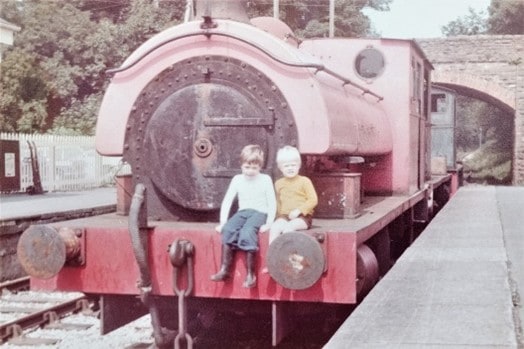
Jeff and Frank sitting on the buffer beam of a rather tired and unloved looking locomotive.

Marilyn remembers catching the train into Taunton for school and the guard holding the train for her if she was a little late!  Frank and Jeff remember walking alongside the track towards Norton and playing on rusting old locos and some old rolling stock.

Mr Frank Pardoe, station master, chorister and gardener.

Frank Pardoe was station master at Bishops Lydeard with responsibility for other stations up to Watchet, from 1952 till 1971 when the line closed, but continued to live in the station house, with May, until 1983.

Mrs Dickenson recalls lorries and wagons drawing up to the goods shed, the building that now houses Gauge Museum Bishops Lydeard, to unload and load chickens, animal feed and various parcels.

© Images subject to copyright: WSRHT/Dickenson Family ©

If you have any stories to share with us, please do email us at info@wsrht.co.uk

Share the Post:

Recent News Posts

WSRHT Board Meeting January 2026 Minutes Published

WSRHT January 2026 Board Minutes

The West Somerset Railway Heritage Trust Board Minutes 28th January 2026

Please click the image to view 

Board Meeting 28th January 2026

Join us as a Museum Volunteer.

WEST SOMERSET RAILWAY HERITAGE TRUST

DO YOU:

Love a bit of history?

Enjoy chatting to people?

Happy to work with children and families?

Keen on the WSR and its heritage?

If you’ve nodded “yes” to any of the above, we’d love you to join us as a museum volunteer.

Gauge Museum at Blue Anchor

We’re looking for volunteer stewards for the Gauge Museum at Blue Anchor Station on running days during the school holidays and for special events.

You’ll have an induction period alongside a mentor, and we’re very happy to arrange part-day shifts.

The role is simple: welcome visitors, share a little about the museum, and work alongside the station staff.

Interested (or just curious)? Please email Ian Camp (Curator) via info@wsrht.co.uk and put “Blue Anchor stewarding” in the subject line.

Fancy getting involved over at Bishops Lydeard?

We’re on the lookout for more friendly faces to join our team, especially as the museum is getting bigger and busier these days!

If Bishops Lydeard sounds like your kind of place, just drop us a line using the same email, but pop “Bishops Lydeard stewarding” in the subject so we know what you’re after!

And don’t forget – you can always support the WSRHT by becoming a member. Just ping us at info@wsrht.co.uk and pop “membership” in the subject line.

Keep up with what we’re doing, follow the Trust on Facebook!

 https://www.facebook.com/TheHeritageTrust


WSRHT Board Meeeting March 2026 Minutes Published

WSRHT March 2026 Board Minutes

The West Somerset Railway Heritage Trust Board Minutes 18th March 2026

Please click the image to view 

Board Meeting 18th March 2026