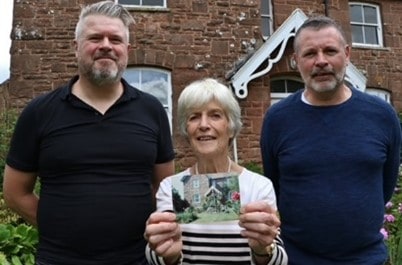
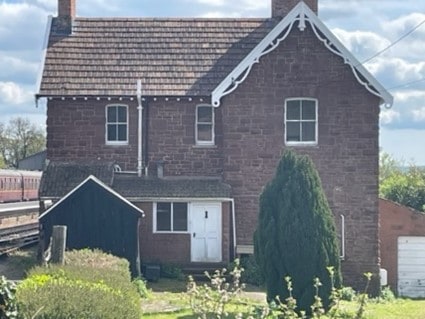
The West Somerset Railway (WSR) and the West Somerset Railway Heritage Trust (WSRHT) had the pleasure of welcoming back to her home of many years the Station Masters House, Bishops Lydeard, Mrs Marilyn Dickenson and her two sons, Frank and Jeff.
Jeff, Marilyn and Frank
The occasion was to mark a special birthday for Marilyn Dickenson, who is the daughter of the last station master, Frank Pardoe, at Bishops Lydeard station.
Frank Pardoe began his railway career in 1921 at Worcester, joining as a junior clerk on the GWR. In 1927 he was transferred to Birmingham. Then in 1945 still in Birmingham he was attached to the divisional superintendent’s office as a relief clerk and relief station master. In 1951 he was appointed station master at Bishops Lydeard taking over from retiring station master Mr Webber, known as Judge Webber, and moved to Somerset with his wife May (nee Parry) and two daughters, Marilyn Dickenson and her sister Janet.
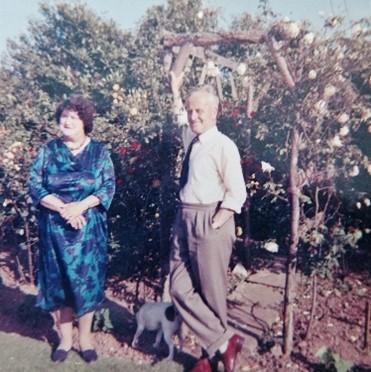
Frank & May Pardoe enjoying the rose arbor in the garden at Station House.
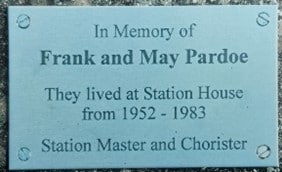
The plaque in Bishops Lydeard Parish church commemorating Frank & May.
Mrs Pardoe, (May) before she met and married Frank, was a well-known sprinter in Midland athletic circles and was a member of the famous Birchfield Harriers Women’s team which won the British championship at Stamford Bridge in the early 1920’s! After living as a full-time homemaker May worked for a period as a typist at Norton Military Camp.
Mr Pardoe was also able to indulge his passion for choral singing in Bishops Lydeard Parish church, where one can see a small plaque in memory of Frank & May.
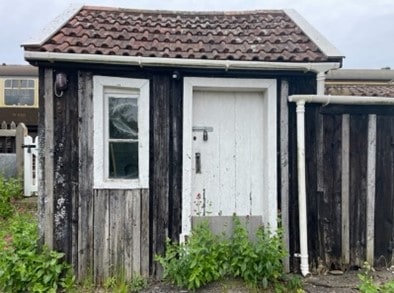
The former washhouse now potting shed with coal shed/Bess the pony’s stable.
Marilyn was able to relive her time living in the station master’s house showing us where they got their hot water from, the shed that Janet housed her pony, Bess, and that was later used as a coal shed.
When they moved into the house there was no electricity, even in the early 1950’s, and heating was via coal fires in every room, until gas was installed and then the lounge was fitted with the luxury of a gas fire.
The family generally ate in the kitchen, there was a coke stove in the recess in the kitchen for heat and hot water, with the pantry at the far end. Once gas was installed a gas cooker was an added luxury.
The back door to the house with garage to the right where the chicken house was.
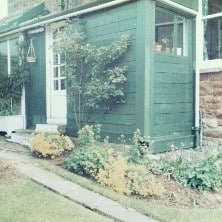
The wooden porch over the back door also enclosing the butlers sink.
As Marilyn walked around the gardens, she pointed out that where the garage is now, was where her father had his chicken house and run. The potting shed formerly the wash house. In this shed was a large round brick structure that held an open basin, heating the water for washing, by an open fire underneath. The mangle was also stored in the shed. The current butler sink to the right of the back door, was originally enclosed in a wooden porch.
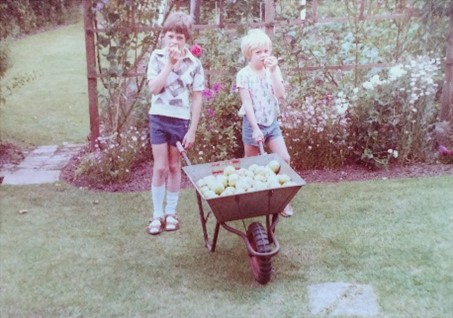
Frank and Jeff helping Grandad Frank pick the apples.
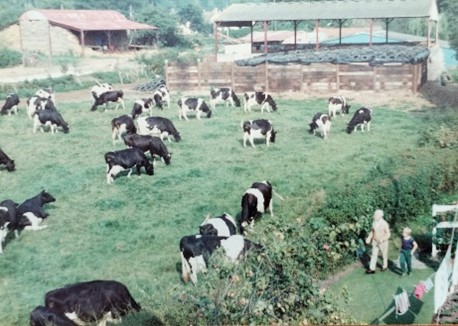
The view from the top bedroom overlooking Pattemores farm plus their cows with Mr Pardoe and grandson in the bottom RH corner.
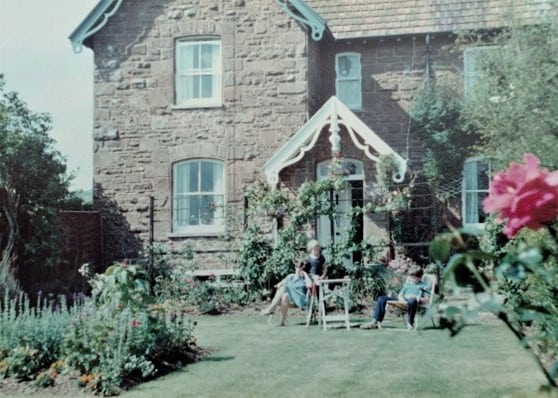
Marilyn, Frank and Jeff enjoying the sun and afternoon tea in the front garden of the house.
The back garden was an orchard garden with a small lawn area bordered by a narrow flower bed with a rose trellis screening a large vegetable garden. Frank Pardoe was a keen gardener and grew runner beans, potatoes, cabbages etc. He also made and tended the flower beds on the platforms. Beyond the vegetable garden was a small area of fruit trees and beyond, that near the cattle dock, a large greenhouse.
There was no driveway to the house, access to the house was down the platform ramp along the track to the entry gate by the potting shed.
The front garden was mainly lawn with a central rectangular bed of pink and white roses, bordered by Geraniums. The cobbled terrace with steps leading down to the lawn. The garden was wider than it is now bordered on the right side by a laurel hedge, the current lonicera hedge was not there. The hedge was a lot lower enabling the family to see over the hedge to Pattemore’s farm and the cows in the field.
On the trackside there was another gate with access directly to trackside, again with a lower hedge of mixed shrubs with a flower border in front. At the end of the garden was a low hedge with access to Frank’s allotment, the hedge being low enough to allow a view up the line.
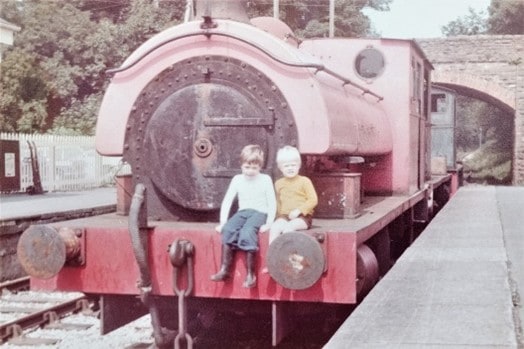
Jeff and Frank sitting on the buffer beam of a rather tired and unloved looking locomotive.
Marilyn remembers catching the train into Taunton for school and the guard holding the train for her if she was a little late! Frank and Jeff remember walking alongside the track towards Norton and playing on rusting old locos and some old rolling stock.
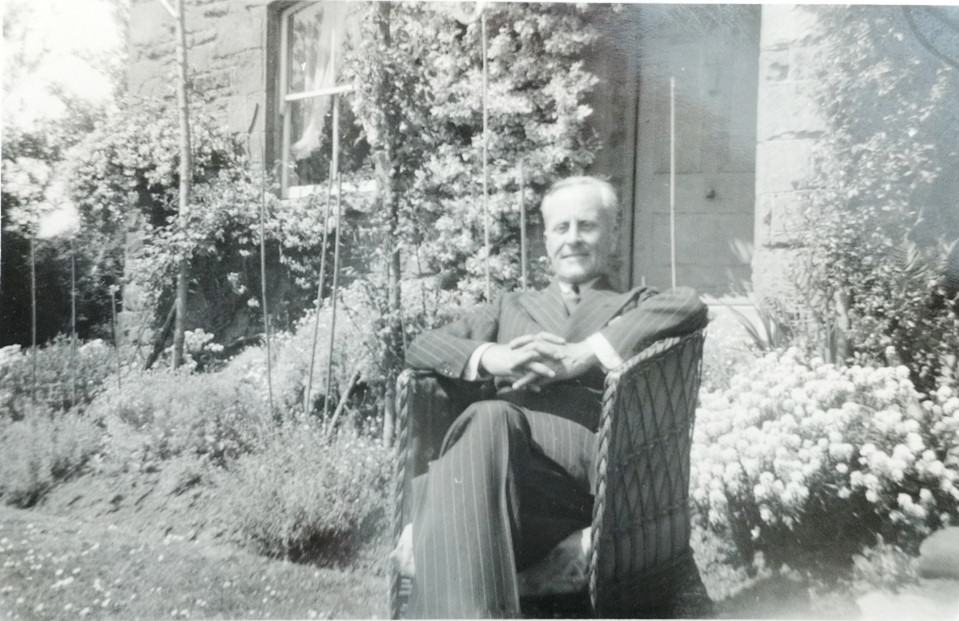
Mr Frank Pardoe, station master, chorister and gardener.
Frank Pardoe was station master at Bishops Lydeard with responsibility for other stations up to Watchet, from 1952 till 1971 when the line closed, but continued to live in the station house, with May, until 1983.
Mrs Dickenson recalls lorries and wagons drawing up to the goods shed, the building that now houses Gauge Museum Bishops Lydeard, to unload and load chickens, animal feed and various parcels.
The Gauge Museum at Bishops Lydeard on the West Somerset Railway has been awarded Full Accreditation by the Arts Council. The Museum, which is run by the West Somerset Railway Heritage Trust, holds a wide range of artefacts which display and tell the story of the history and heritage of the West Somerset Railway and the Great Western Railway.
Administered by Arts Council England on behalf of the UK Accreditation Partnership, Accreditation is the benchmark for well-run Museums and Galleries.
It means that the Gauge Museum is properly managed and governed to the nationally agreed industry standard and shows the museum takes proper care of its collections, sharing them with visitors and keeping them safe for future generations.
Accreditation opens up exciting funding opportunities, allows museums to host touring exhibitions and gives access to professional advice and support. It also gives confidence to donors and sponsors who may wish to support the museum in preserving heritage and inspiring future generations
Steve Williams, Trust Vice Chairman and Trust Accreditation Lead said: “This is a fantastic outcome for the Trust and marks the combination of three years of hard work by a small and dedicated team of volunteers many of whom now make up our Museum Management Team. This means that the Trust is recognised as working to a high standard of Museum and collections management and care. We now have to ensure that we deliver to those standards and continue to make the Gauge Museum as welcoming and as interesting an experience for visitors and volunteers alike”.
Ian Camp, Trustee and Museum Curator said: “This achievement represents a significant milestone for our museum. The progress we have made is the result of the unwavering dedication and hard work of our team over the past several years. Their commitment has been instrumental in reaching this important point in our journey.
We would also like to extend our sincere gratitude to Rachel Bellamy, our Museum Development Officer, whose support and guidance have been invaluable throughout this process. Her expertise has helped steer us in the right direction and ensured that we met the necessary standards for accreditation.
Securing this recognition marks another important step towards fulfilling our vision of being a professional museum, managed and operated by a group of passionate and committed volunteers.”
Helen Anson, Trustee and Museum Professional Adviser said: “This is a defining moment for the Heritage Trust. By gaining accreditation we have demonstrated our deep commitment to our museums service, setting high standards in organisational health, collections care and management and visitor experience. The contribution from the whole team has been outstanding and their passion for embedding excellence across the organisation will ensure that we continue to build on this success over the coming years.”
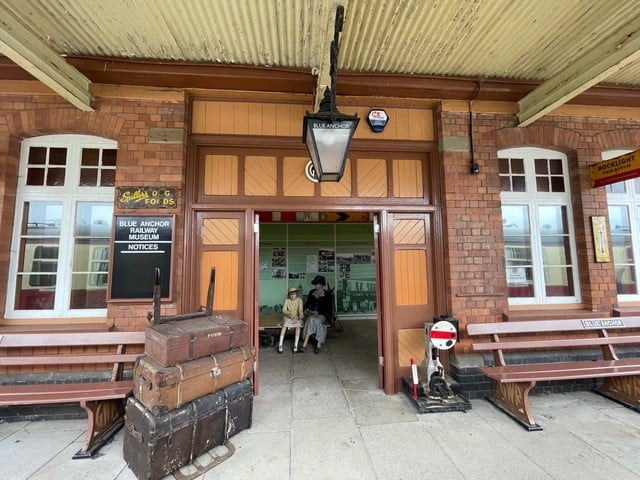
Having gained Accreditation for the Gauge Museum, the Trust will in 2026 be pursuing a similar outcome for its other site at Blue Anchor station on the WSR which is now opened to visitors again following an extensive programme of refurbishment and reinterpretation.
The West Somerset Railway Heritage Trust is pleased to publish the minutes of its August Board Meeting on Thursday, 7th August 2025.
Please click the Board Meeting link to access the document as a pop-up tab. Alternatively, to view all Trust Board Meetings since 2016 –view the collection.
The Trust is pleased to announce that the Gauge Museum Blue Anchor has reopened in April. The website on the Gauge Museum Blue Anchor has new photos of the Museum’s interior and new panels showing lots of information.
Please do have a visit to the new webpage under Museums > Gauge Museum Blue Anchor drop down. Alternatively click here.
Thank you for spending your time visiting the Railway and the Heritage Trust.
Manage Consent
To provide the best experiences, we use technologies like cookies to store and/or access device information. Consenting to these technologies will allow us to process data such as browsing behaviour or unique IDs on this site. Not consenting or withdrawing consent, may adversely affect certain features and functions.
Functional
Always active
The technical storage or access is strictly necessary for the legitimate purpose of enabling the use of a specific service explicitly requested by the subscriber or user, or for the sole purpose of carrying out the transmission of a communication over an electronic communications network.
Preferences
The technical storage or access is necessary for the legitimate purpose of storing preferences that are not requested by the subscriber or user.
Statistics
The technical storage or access that is used exclusively for statistical purposes.The technical storage or access that is used exclusively for anonymous statistical purposes. Without a subpoena, voluntary compliance on the part of your Internet Service Provider, or additional records from a third party, information stored or retrieved for this purpose alone cannot usually be used to identify you.
Marketing
The technical storage or access is required to create user profiles to send advertising, or to track the user on a website or across several websites for similar marketing purposes.